If you run a contracting business and your phone is ringing less than it did 18 months ago, and you can’t quite explain why, you are not imagining it. You are also not alone.
Something fundamental shifted in how homeowners find contractors, and most of the industry hasn’t caught up. The contractors who have caught up are quietly capturing market share from the ones who haven’t. Not because they’re better at their trade. Because they’re easier to find in a search environment that no longer looks anything like the one we built our marketing playbooks around.
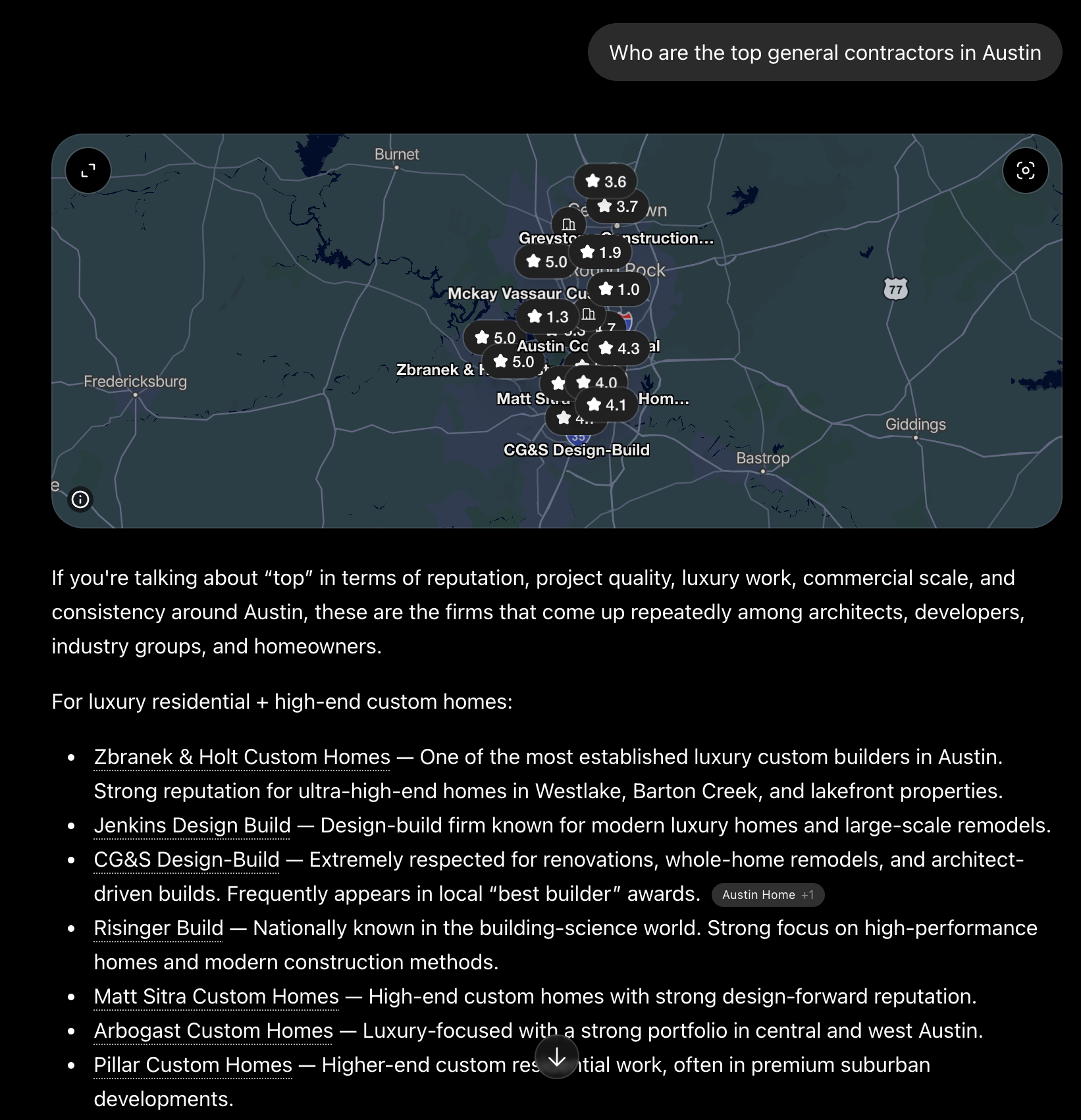
Here’s the picture in plain language. A homeowner with a leaking roof in 2022 typed “roofer near me” into Google, scrolled past two ads, clicked one of the top three organic results, and called whoever loaded first. In 2026, that same homeowner asks ChatGPT, “Who’s the best storm-damage roofer in my zip code with good reviews and fast response times?”, and gets back three named contractors with summaries of why each one is trustworthy. No scroll. No comparison. No click.
If your contracting business isn’t one of those three names, you didn’t lose a lead. You were never in the conversation.
That is the new reality of contractor digital marketing. The channels shifted. The buying journey shifted. The very shape of the search results page shifted. And the marketing budget most contractors are still running was designed for a world that no longer exists.
This guide is the long version of what we tell every contractor who calls us asking why their lead flow feels off, what’s actually changed in search, why traditional SEO is still necessary but no longer sufficient, what AI search optimization (often called GEO, or Generative Engine Optimization) actually looks like in practice, and how to build a marketing system that wins across all three search surfaces at once: classic organic results, AI-generated answers, and local intent channels like Google Business Profile and Local Services Ads.
If you read one thing this quarter before your busy season hits, make it this.
Part 1: What Actually Changed in Search (And Why Contractors Got Hit Hardest)
Zero Click Searches Are Now the Default
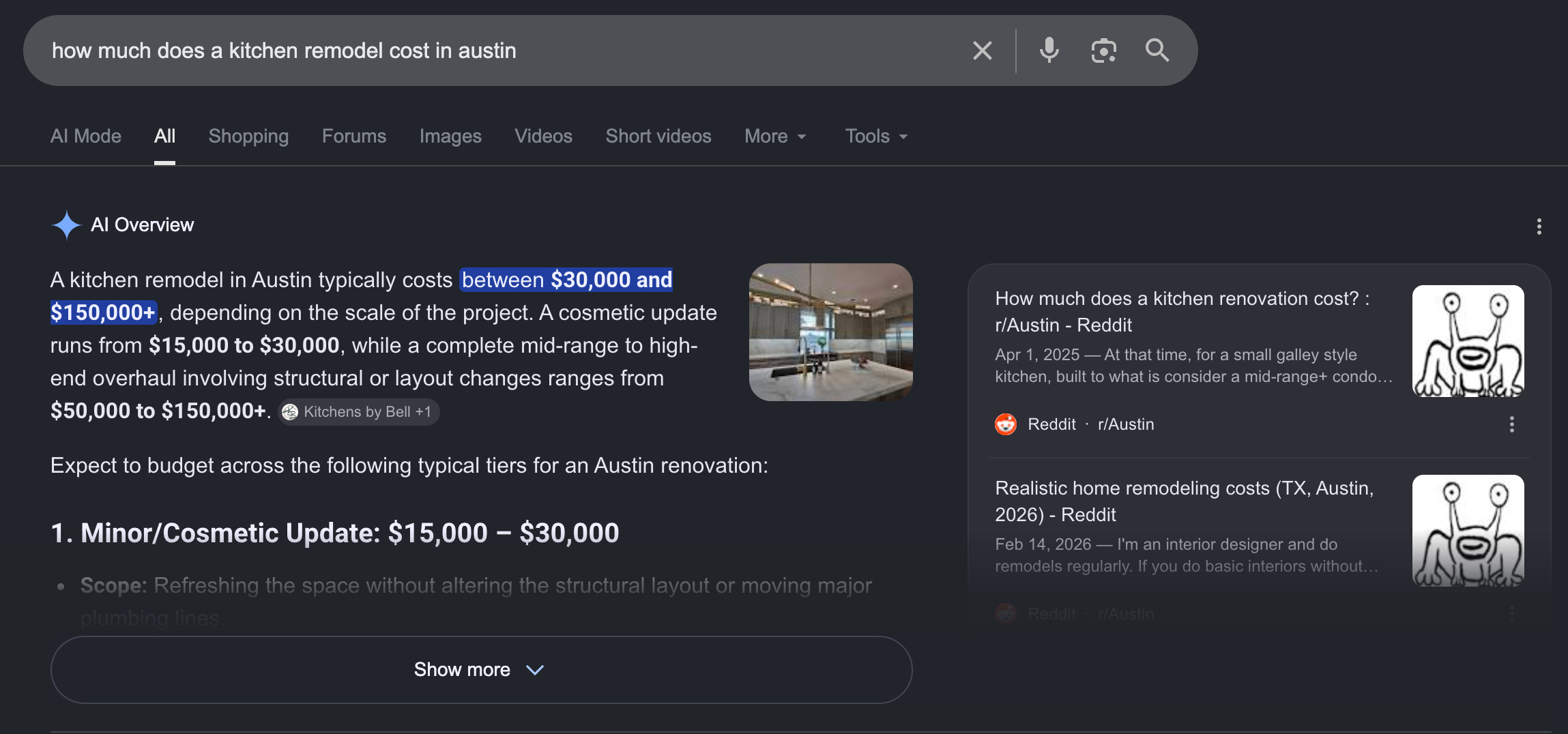
The single most important statistic in digital marketing right now: roughly 58.5% of U.S. searches now end without a single click to any website, according to Semrush’s 2025 zero-click study. On mobile, where the vast majority of contractor searches happen, that number jumps to 77.2%.
Let that sink in. Of every ten homeowners searching for something contractor-related on their phone, almost eight will get an answer without ever visiting a website. Including yours.
The number gets worse when AI Overviews enter the picture. Click-Vision’s 2026 analysis found that searches triggering AI Overviews now show an average zero-click rate of 83%, versus around 60% for traditional queries. When Google generates an AI summary at the top of the page, only about 1% of users click through to the cited source, per Semrush’s 2025 SERP data.
Think about what this means structurally. You can rank in position one. You can have the best service page on the internet. And if Google decides to answer the query with an AI Overview, your click-through rate quietly collapses. Digital Bloom IQ reported a 47% reduction in CTR on pages affected by AI Overviews.
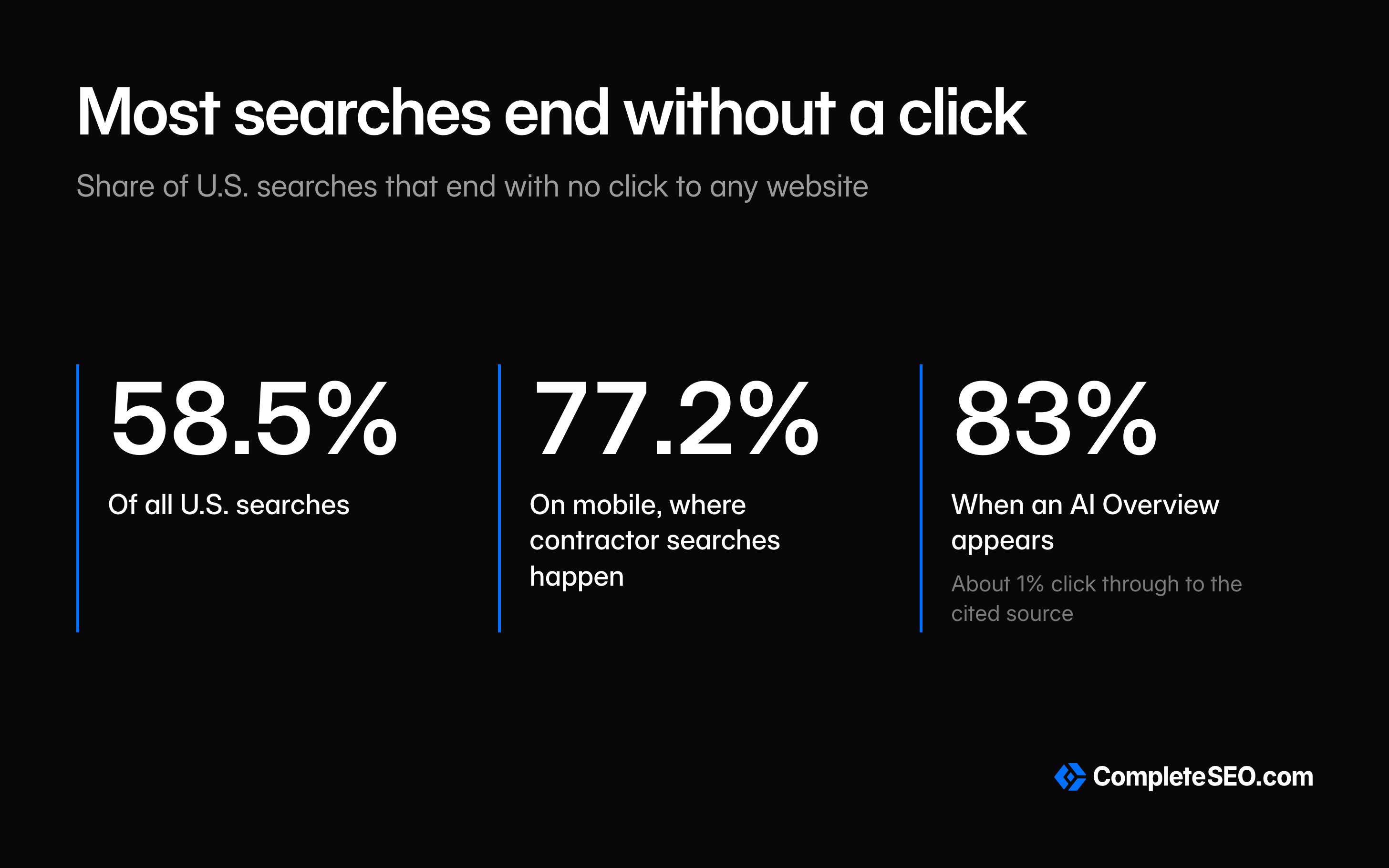
For contractors, this is brutal, because the queries most likely to trigger AI Overviews are exactly the informational and comparison queries that homeowners use before they pick a contractor. “How much does a roof replacement cost in Phoenix.” “Signs you need a new HVAC system.” “Permit requirements for a bathroom addition.” Three years ago, these searches drove top-of-funnel traffic to contractor blogs. In 2026, Google answers them inline, and the homeowner moves on, or asks a follow-up to ChatGPT.
The Migration to AI Platforms Is Real, But Volatile
The flip side of the zero-click problem: people aren’t searching less. They’re searching somewhere else.
AI platforms collectively drove more than 1.13 billion referral visits in June 2025 alone, up roughly 357% year over year, according to widely circulated SimilarWeb and Profound data. ChatGPT search referral traffic to small and medium businesses grew 123% between September 2024 and February 2025, per a study cited by OptiWeb Marketing.
But here’s the part most marketing blogs leave out: that same OptiWeb analysis noted that ChatGPT referral traffic then dropped about 52% between late July and September 2025 as OpenAI adjusted how it surfaces sources. AI referral traffic is real, but it’s volatile. The contractors treating it as a stable channel are setting themselves up for a bumpy ride.
The lesson isn’t “ignore AI search.” The lesson is that AI search visibility isn’t a traffic channel, it’s a trust signal and a consideration channel. When ChatGPT cites your business in an answer, that homeowner may not click. But they read your name, your service area, and a summary of why you’re credible. They’re more likely to search you directly afterward, find you on Google Maps, or remember you when the urgent moment hits.
This is the shift in mental model that most contractors haven’t made yet. The goal is no longer “drive traffic to your website.” The goal is “be the answer.”
Search Behavior Itself Changed, And Contractor Verticals Got Hit First
WebFX’s analysis of 3,000+ contractor-related queries in 2025 found something striking: search behavior in home services is bifurcating into two very different patterns.
Pattern one is problem-first searching. Homeowners are increasingly typing the symptom, not the solution. “Why is my AC making a grinding noise” gets 2,400+ monthly searches and has grown 125% in five years. “Running toilet fix” gets 5,400 searches and grew 80%. “How much does it cost to replace a water heater” gets 2,400 searches and grew 140%. People are researching their problem before they decide they need a contractor.
Pattern two is urgency searching, and it has exploded:
Emergency Query
January 2019 Volume
January 2025 Volume
Growth
Emergency plumber
18,100
74,000
+309%
24 hour plumber near me
6,600
33,100
+402%
Emergency HVAC repair
260
6,600
+2,438%
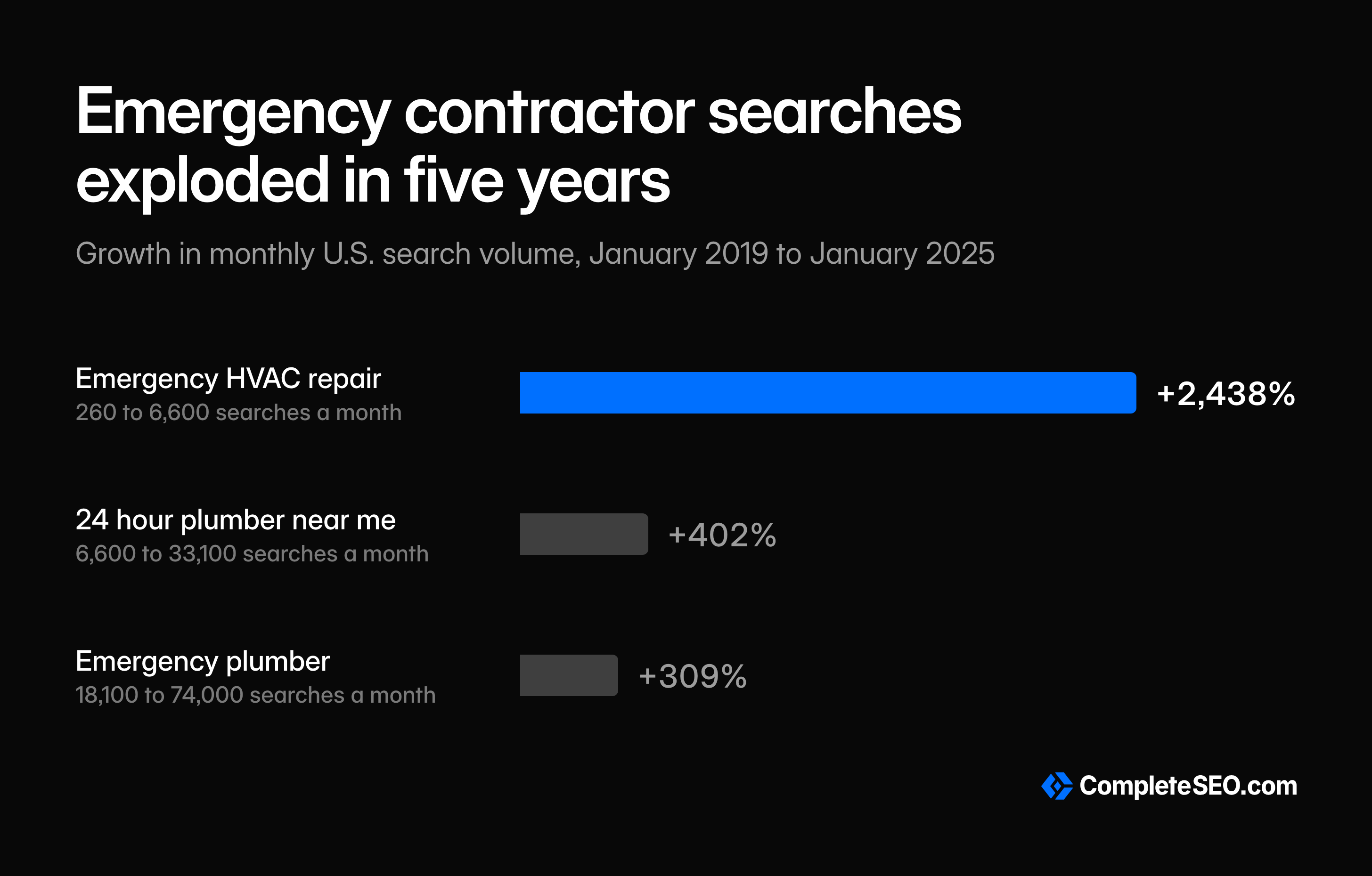
These are not browsing sessions. They are people with broken homes and a window of minutes to find a fix. The contractor who shows up clearly and immediately, in the AI answer, in the map pack, in the LSA carousel, gets the call. Everyone else gets nothing.
And generationally, the language is shifting. Gen Z averages 5.83 words per query versus 5.15 for Boomers, and 43.57% of Gen Z searches are phrased as questions versus 23.22% for Boomers, per WebFX. The contractors whose content is structured around conversational questions, not just keyword phrases, are the ones being surfaced when ChatGPT and Perplexity build their answers.
Why Contractors Specifically Got Hit Harder Than Most Industries
E-commerce can absorb some of the AI Overview impact because product searches still have a strong “compare and buy” step that requires clicking. SaaS can ride out the shift because B2B research journeys are long and multi-touch.
Contractor marketing has neither of those buffers. The journey is short. The intent is high. The decision is local. And the entire funnel can collapse into a single AI-generated answer that names three businesses in your service area. If yours isn’t on the list, you don’t get a second chance the way an e-commerce brand might through retargeting or paid social.
That’s why the contractors winning right now are the ones treating AI visibility, traditional SEO, and local intent channels as a single integrated system, not three separate marketing line items.
Part 2: Traditional Contractor SEO, Still the Foundation, Just No Longer the Whole House
Before we get to the AI-specific tactics, a clarification that matters. SEO did not die. Anyone telling you to abandon technical SEO and chase AI tactics is selling you something.
What actually happened is that traditional SEO became necessary but insufficient. The fundamentals still drive a meaningful share of contractor leads, and more importantly, the same structural work that earns Google rankings is what makes your content extractable by AI systems. You can’t have one without the other.
Here is what still drives results in 2026, and what we see in actual contractor accounts every week.
Technical SEO Is the Floor You Build Everything On
If your contractor website takes four seconds to load on mobile, you’ve already lost half your visitors before the page renders. Google’s Core Web Vitals, Largest Contentful Paint, Interaction to Next Paint, Cumulative Layout Shift, are explicit ranking signals. Mobile responsiveness is non-negotiable when 60%+ of contractor searches happen on phones.
The unglamorous checklist that still matters:
· Page load under 2.5 seconds on mobile. Test with PageSpeed Insights, fix the biggest offenders (usually images and bloated theme code).
· HTTPS, clean URL structures, no broken internal links. This is the boring stuff that compounds.
· A logical XML sitemap and a robots.txt that doesn’t accidentally block half your site. We’ve audited contractor sites where the entire /services/ directory was disallowed and nobody knew.
· Schema markup that validates. More on this below, it’s even more important for AI than for Google.
· Crawlable navigation. If your menu is built in JavaScript that Googlebot can’t render, your service pages are invisible.
Keyword Targeting With Real Intent Mapping
A homeowner typing “how much does a kitchen remodel cost” is in a completely different mental state from one typing “kitchen remodeling contractor near me.” Same topic. Different intent. Different page. Different call to action.
Smart contractor SEO maps every priority keyword to one of four intent buckets and builds the appropriate page type:
Intent Type
Example Query
Page Type
Primary CTA
Informational
“signs you need a new roof”
Educational article with FAQ schema
Free inspection signup
Commercial Investigation
“best roofing contractor Denver”
Comparison or “best of” landing page
Get quotes / consult
Transactional
“roof replacement quote near me”
Service page with form above the fold
Call now / book
Navigational
“[Your Brand] reviews”
Reviews/about page
Call / contact
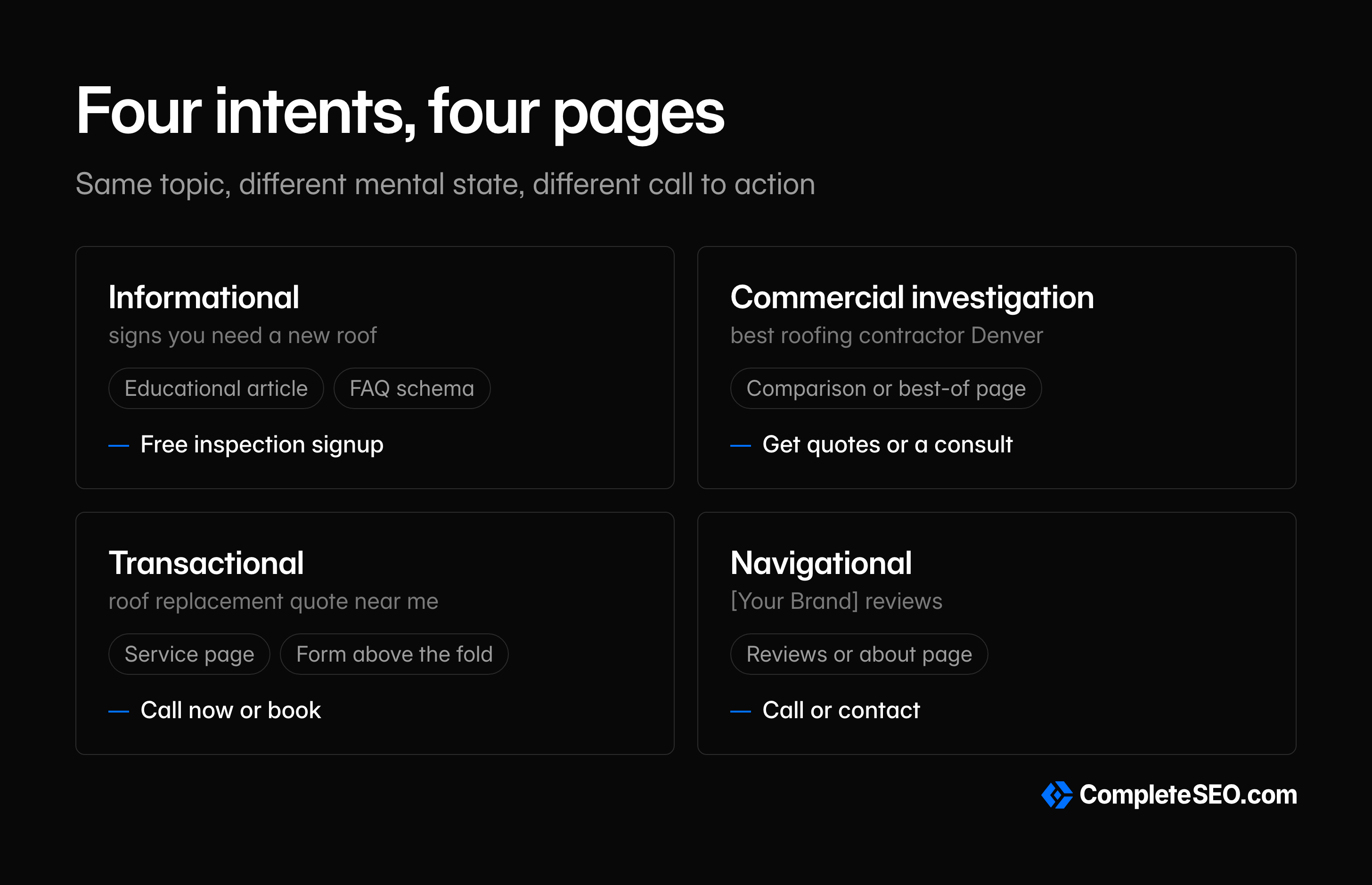
Most contractor websites have one or two transactional service pages and nothing else. That’s why their funnel is brittle, they’re invisible at every stage of the homeowner’s journey except the last one.
Local SEO: Where Contractor Marketing Actually Lives or Dies
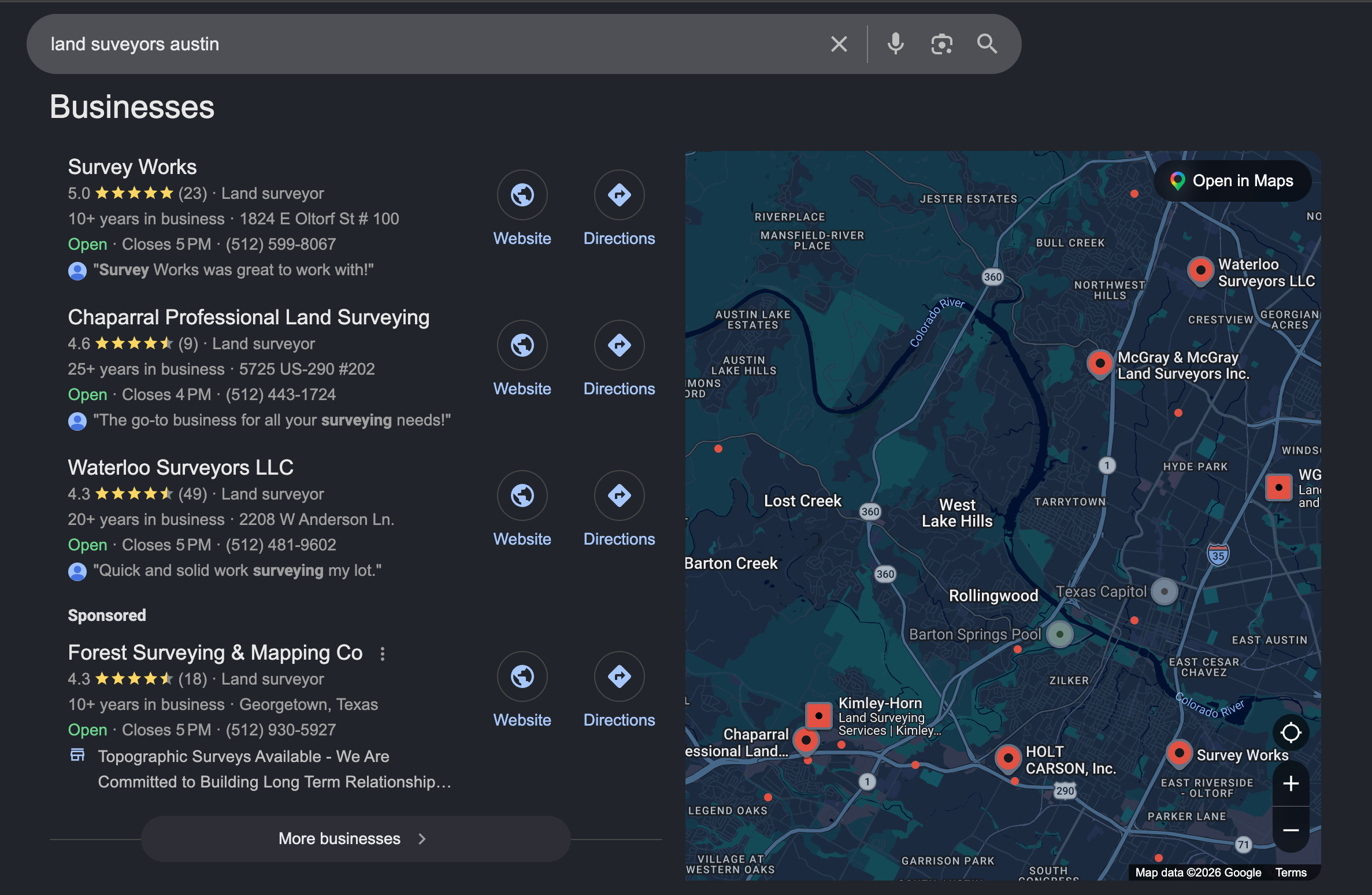
For contractors, SEO is almost entirely a local game. National authority matters far less than whether you dominate the map pack in your specific service area. The signals that drive local rankings in 2026:
1. Google Business Profile completeness and activity (more on this in Part 4)
2. NAP consistency, name, address, phone identical across every directory and citation
3. Service area coverage, dedicated pages for every city and neighborhood you serve
4. Reviews, volume, recency, velocity, and response rate
5. Local backlinks, from local news, chambers of commerce, suppliers, and community organizations
6. On-page geographic relevance, actual mentions of neighborhoods, zip codes, and landmarks in your content
Generic directory submissions are dead weight. What still moves the needle: editorial mentions in local news, partnerships with local suppliers and adjacent trades, sponsorships of community events that earn real backlinks, and case studies that local industry publications actually want to cover.
On-Page Optimization Is the Translation Layer Between Your Business and the Machines
Title tags, meta descriptions, H1/H2 structure, internal linking, FAQ sections, alt text on images, none of this is exciting, but all of it is how search engines (and now AI systems) extract and categorize what your pages are about.
The contractors who get on-page SEO right tend to perform well in both traditional rankings and AI-generated answers for the same underlying reason: structured content is readable by both humans and machines. A page with clear question-based H2s, short paragraphs that directly answer those questions, a comparison table, and an FAQ section with schema is easier for Google to rank and easier for ChatGPT to extract a citation from.
This is the secret hiding in plain sight. The work that wins AI citations is largely the same work that has always won SEO, it just has to be executed with more discipline.
Part 3: How AI Search Is Reshaping Contractor Marketing, The Specifics
This is where contractor digital marketing gets genuinely interesting, and where most general digital marketing agencies still get it wrong because they’re applying e-commerce and SaaS playbooks to a vertical that doesn’t work that way.
Home services is a high-intent, geographically constrained, trust-driven vertical. When someone searches for a roofer or an HVAC technician, they are not doing abstract research. They have a real problem, a specific location, a budget range, and a window of time. AI search systems handle those queries very differently than they handle broad informational searches, and the differences are where the opportunity lives.
E-E-A-T Is No Longer Abstract, It’s the Dividing Line
Google’s E-E-A-T framework (Experience, Expertise, Authoritativeness, Trustworthiness) was something most contractors could safely ignore for years. In 2026, it’s the single biggest determinant of whether AI systems will cite your business.
What this means in concrete terms for a contractor:
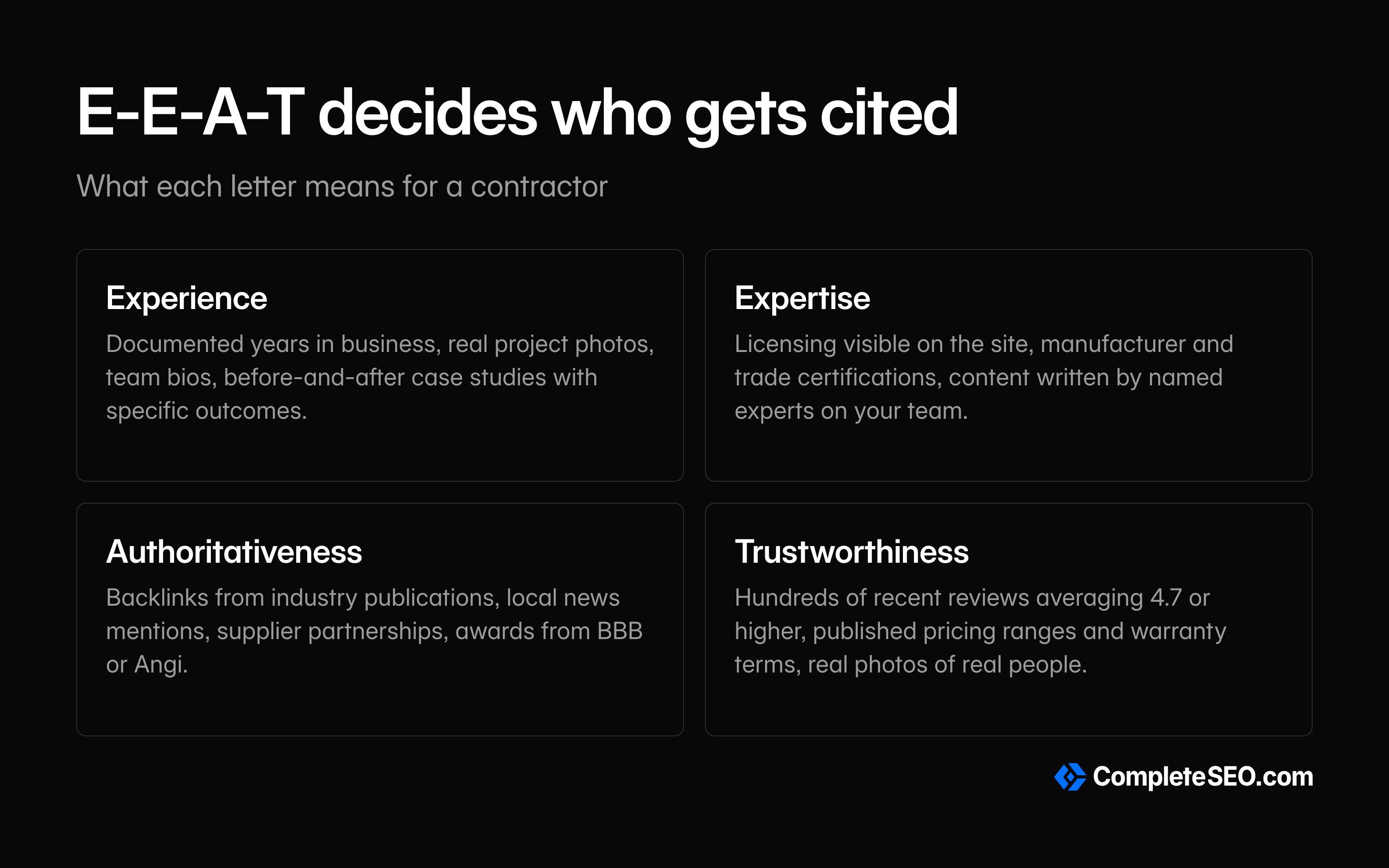
· Experience: Documented years in business, project portfolios with real photos (not stock), team bios with credentials, before-and-after case studies with specific outcomes.
· Expertise: Licensing information visible on your site, certifications from manufacturers and trade associations, content written by named experts on your team, technical depth in your service pages.
· Authoritativeness: Backlinks from industry publications, mentions in local news, partnerships visible on supplier websites, awards from credible bodies (BBB, Angi, etc.).
· Trustworthiness: Hundreds of recent reviews averaging 4.7+, transparent pricing or clear “starting at” ranges, warranty terms published on-site, an actual privacy policy, real photos of real people.
A roofing contractor with 15 years documented, a Google Business Profile showing 300+ reviews averaging 4.8 stars, eight detailed case studies with measurable outcomes, and licensing displayed in the footer looks completely different to ChatGPT than a contractor with a generic template site, three reviews, and a stock photo of a roof.
The first one gets cited. The second one might as well not exist in AI search.
Structured Data Went From “Nice to Have” to “Table Stakes”
Schema markup is how AI systems verify what you do, where you do it, and whether your information matches across the web. For contractors, four schema types matter more than the rest:
1. LocalBusiness schema, with areaServed mapped to specific cities and zip codes you actually serve, not a vague “Greater Phoenix area” string.
2. Service schema, each individual service (roof replacement, gutter installation, attic ventilation) as its own crawlable entity, not buried in a single services page.
3. FAQPage schema, on every service page and city page, written so the answers can be cleanly extracted by an AI Overview.
4. AggregateRating and Review schema, wherever reviews are displayed, properly marked up.
This is not “gaming the system.” Schema markup is the language that AI systems use to confirm a business is real, licensed, operating in a defined area, and trusted by real customers. Without it, you’re whispering. With it, you’re broadcasting in a format the machines actually parse.
Content Has to Be Answer-First, Not Keyword-First
The old contractor SEO model: write a 1,000-word service page targeting “bathroom remodeling contractor Phoenix,” repeat the keyword every 200 words, sprinkle in some related phrases, and wait for rankings. That model still ranks for some queries. It does not get cited by AI.
What does get cited:
· The direct answer in the first paragraph or first sentence. If the page is about kitchen remodel cost, the cost range goes in the opening, not paragraph eight.
· Question-based H2 headings that mirror actual search queries. “How much does a kitchen remodel cost in Denver?” not “Kitchen Remodel Pricing Information.”
· Short paragraphs (2–4 sentences). AI systems struggle to extract clean citations from wall-of-text writing.
· Specific numbers, dates, and named entities. “$42,000 average for a mid-tier kitchen remodel in Denver as of 2025” beats “kitchen remodels can be expensive” every time.
· Bulleted lists and tables for comparisons. These are the easiest structures for AI to lift directly.
If you read the typical contractor service page out loud, it sounds like marketing. If you read a page that gets cited by ChatGPT, it sounds like an expert answering a homeowner’s question in plain English.
Entity Authority: The Concept That Quietly Decides Everything
Here’s the piece most contractor marketing guides miss entirely. AI systems do not evaluate individual pages the way Google’s old PageRank model did. They build entity profiles, a unified understanding of “who is this business, what do they do, where do they operate, and can I trust the information about them.”
That entity profile gets built from every mention of your business across the web: your website, your GBP, your Yelp listing, your BBB profile, supplier directories, local news mentions, social profiles, industry associations. If those mentions are consistent, same business name, same trade specialty, same license number, same service area, same phone, AI systems develop high confidence in your entity. If they’re inconsistent, the AI gets confused, and confused AI doesn’t make recommendations.
The practical implication: an audit of every directory and platform where your business appears, with corrections to anything that doesn’t match exactly, is one of the highest-ROI activities in contractor digital marketing right now. Most contractors haven’t done it. Most agencies don’t even check.
Part 4: Local SEO and Google Business Profile in the AI Era
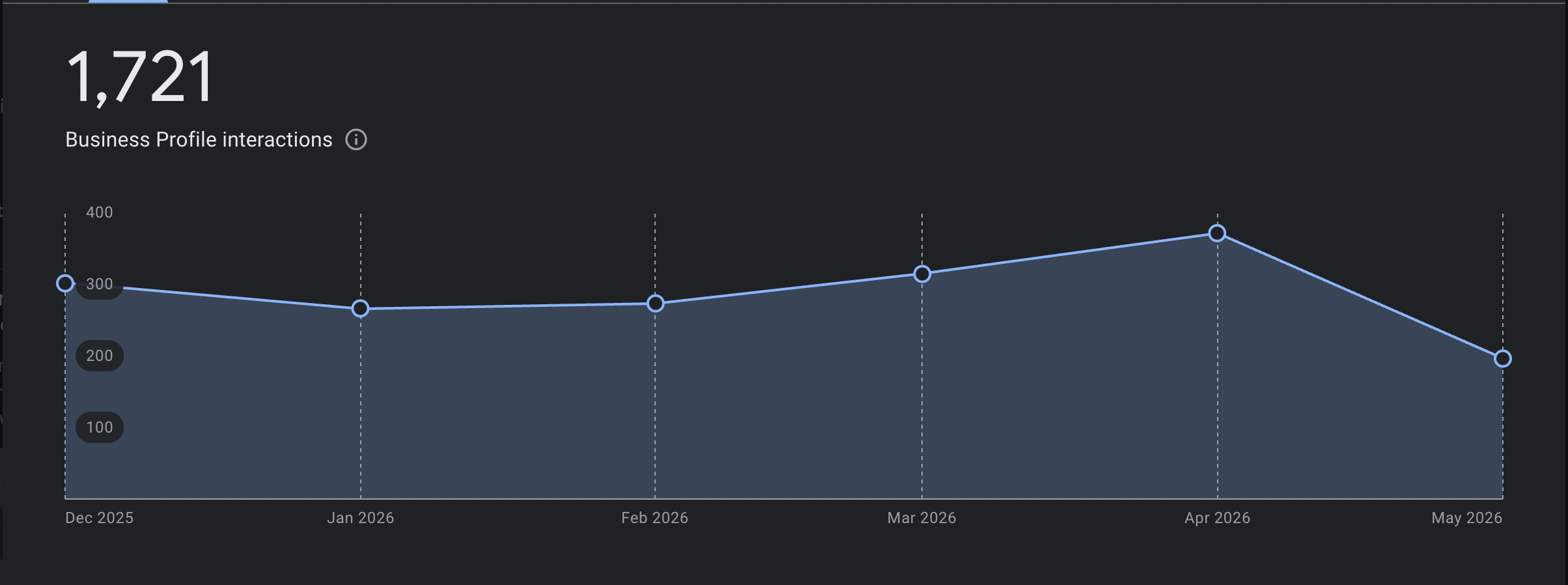
For contractors, the Google Business Profile is the single most important digital asset after the website itself, and arguably more important for AI visibility, because AI Overviews and conversational search tools pull business information directly from GBP data when answering local intent queries.
When a homeowner asks an AI system for “a licensed plumber in Austin with same-day availability,” the response is constructed from GBP categories, services, attributes, reviews, and service area settings. If your profile is incomplete, your profile loses the citation.
The GBP Optimization That Actually Moves Rankings
We’ve watched the same pattern play out across dozens of contractor accounts. The contractors who treat GBP as a one-time setup get one set of results. The contractors who treat it as an active channel get something completely different.
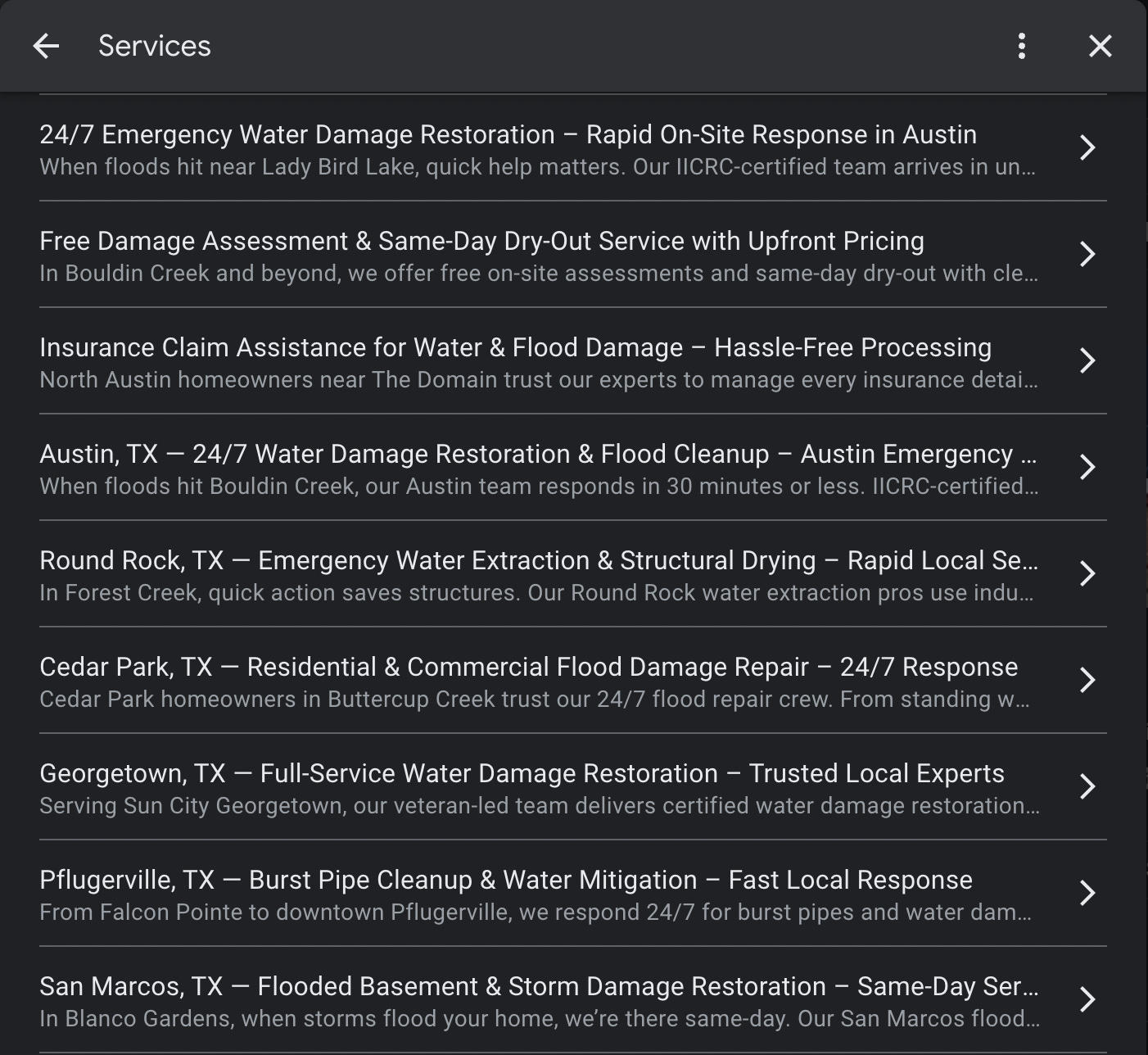
What active GBP optimization looks like:
· Categories and services aligned to actual trade specialties. Use Google’s predefined service options wherever they exist, these carry more weight than custom services. One Phoenix HVAC contractor we work with added 12 predefined services and 4 custom services in early 2025 and moved from position 11 to position 3 for “AC repair Phoenix” within two weeks. That’s not a one-off. We see versions of this regularly.
· Service descriptions written for both humans and AI extraction. Every service description should answer “what does this service include, what’s the typical scope, and what should the homeowner expect” in plain language.
· Products section populated with anything you sell, install, or specialize in (specific equipment brands, materials, finishes).
· Q&A section actively managed. Seed it with the questions homeowners actually ask. Answer them yourself. Then monitor for new questions and respond within hours.
· Posts published weekly, project updates, seasonal offers, educational content. Each post is another signal of activity.
· Photos uploaded consistently, real project photos with proper geotagging where possible, not stock images.
· Review responses for every single review, positive and negative, within 48 hours.
Reviews Are Now Trust Signals for Machines, Not Just Humans
Reviews used to be social proof for human visitors. In 2026, review volume, velocity, and recency are explicit ranking signals for both traditional local search and AI-generated recommendations.
The math is straightforward. A contracting business with 250 reviews averaging 4.9 stars with consistent recent activity sends a fundamentally different trust signal than one with 18 reviews from 18 months ago, even if the older business has been operating for 30 years. AI systems weigh these signals when deciding which contractors to cite, and they specifically privilege Google reviews because of Google’s verification process.
The systematic process that works:
1. Ask for the review within 24 hours of job completion, while the experience is fresh.
2. Send a direct link via SMS, not email. SMS gets a ~4x response rate for review requests in our data.
3. Respond to every review, yes, even the five-stars. Studies show businesses that respond regularly earn 50% more revenue per customer over time.
4. When you get a negative review, respond publicly with empathy and an offer to resolve. Then take it offline.
5. Never offer compensation for reviews. Google detects this and it can suppress your profile.
Google Local Services Ads: The Channel That Quietly Took Over Top-of-Funnel
Local Services Ads have fundamentally changed how contractors compete for new business. As of 2026, roughly 70% of contractors are running LSAs, up from around 28% in 2022, per industry adoption data cited in Geek Powered Studios’ 2026 LSA analysis.
The reason adoption exploded: LSA leads convert to booked customers at approximately 31%, compared to ~12% for standard Google Ads. Cost per verified lead in home services typically runs $40–$95 depending on trade. Consumers prefer LSA results to standard Google Ads by a margin of 29% to 11%, and LSAs capture ~42% of initial clicks in competitive service categories.
For high-ticket trades like roofing, the ROAS can hit 21:1 when the cost-per-lead is in the $150 range and the average job is $12,000+. That’s the kind of math worth running for your own trade.
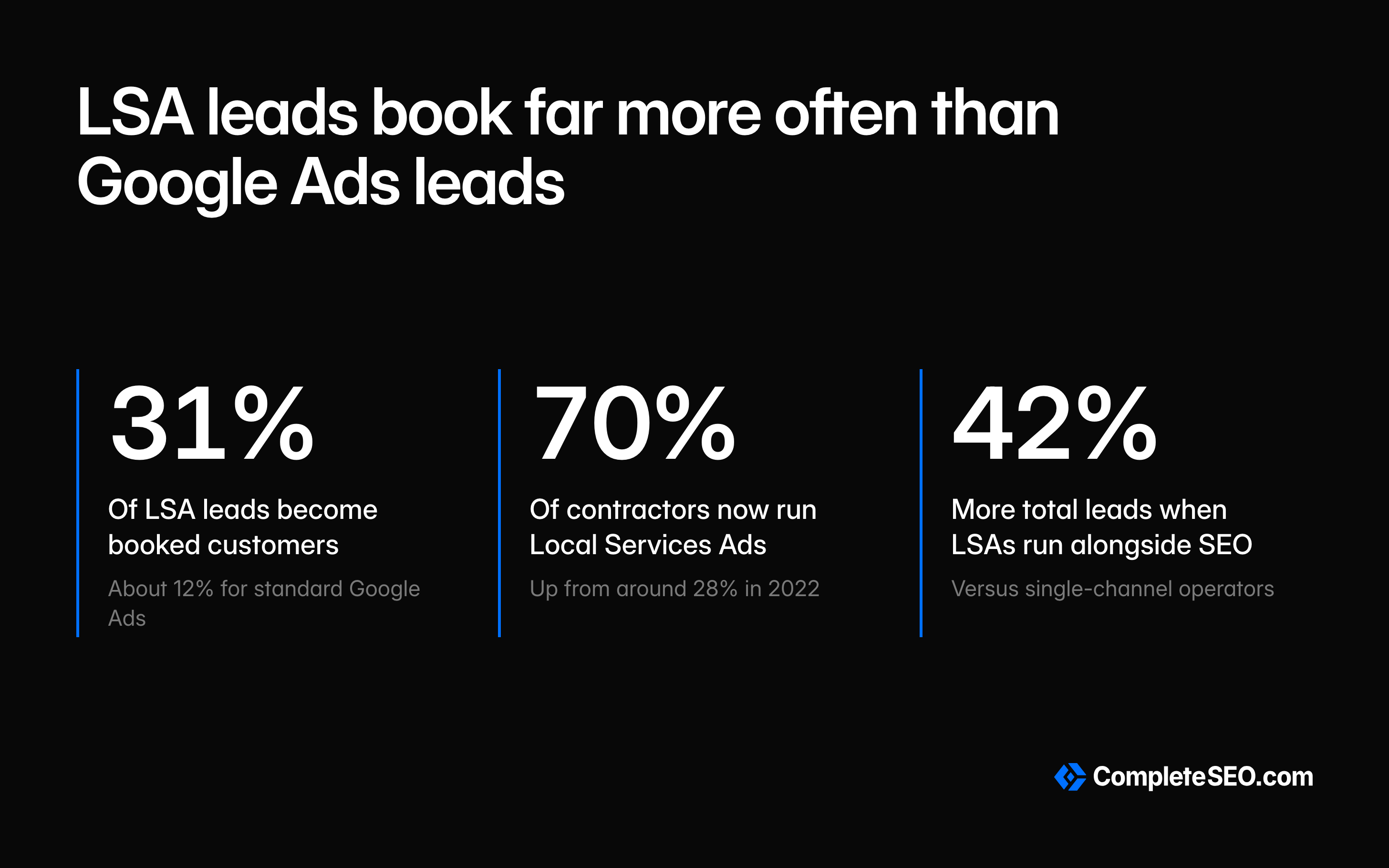
But here’s the part most contractors miss: LSA and SEO are not either/or. Contractors combining LSAs with an active SEO program generate 42% more total leads than single-channel operators, per Semrush’s 2025 local search study. LSA gives you immediate cash flow in 2–5 weeks. SEO gives you compounding organic traffic over 6–12 months. GEO gives you AI citation authority that’s still being claimed. The stack works because each channel reinforces the others, your reviews from LSA jobs strengthen your organic local rankings, your SEO content builds the trust signals that AI cites, and your GBP visibility supports all three.
Part 5: GEO, Generative Engine Optimization for Contractors, Explained Without the Hype
Generative Engine Optimization (GEO) is the layer of search optimization that targets AI-generated answers specifically, and for contractors, it’s the biggest untapped opportunity in digital marketing right now.
Andreessen Horowitz framed the shift succinctly: in a world of AI-generated outputs, the goal is no longer click-through rates, it’s reference rates. How often does the model cite you as a source? How often does your brand appear in the answer the user actually reads?
GEO is not a replacement for SEO. It’s the layer that sits on top. The tactics overlap significantly with good SEO, which is good news for contractors who already have their fundamentals in place. But the GEO-specific tactics are worth understanding on their own.
The GEO vs. Traditional SEO Comparison Table
Dimension
Traditional SEO
GEO (Generative Engine Optimization)
Primary goal
Rank on SERPs
Get cited in AI-generated answers
Success metric
Clicks, sessions, conversions
Citation rate, share of voice in AI answers, branded search lift
Content structure
Keyword density, 1,000+ word pages
Answer-first, structured for extraction
Authority signal
Backlinks + domain authority
Entity consistency + multi-source verification
Schema priority
Helpful for rich results
Essential for AI understanding
Geographic targeting
City + state in title tags
Service area schema + named neighborhood content
Trust signals
Reviews + about page
Reviews + verified credentials + cross-platform consistency
Time horizon
6–12 months to compound
3–6 months for early movers, harder once mature
The GEO Tactics That Actually Work for Contractors
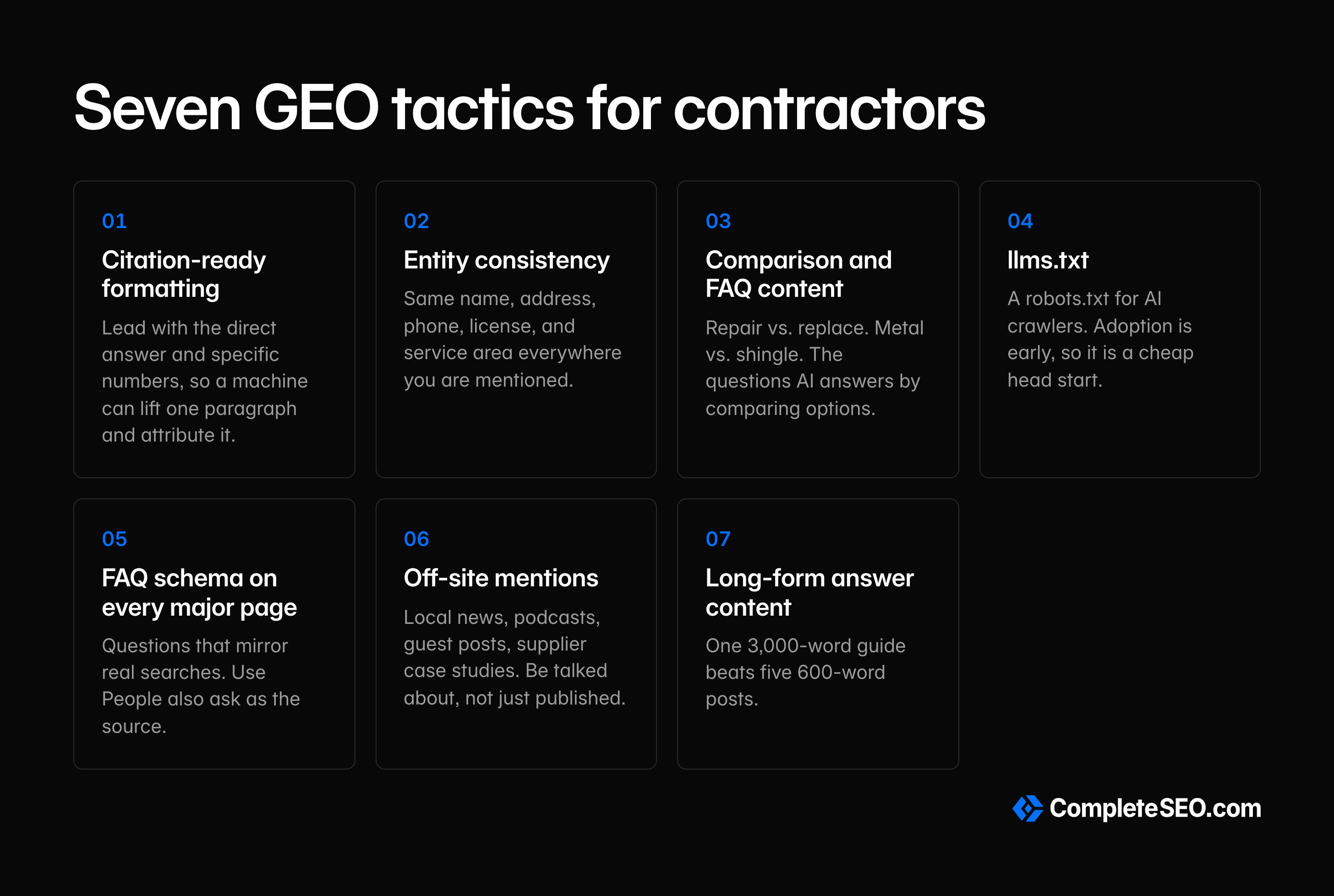
1. AI Citation-Ready Content Formatting. Your content needs to be structured so AI systems can extract clean, attributable information. That means leading with direct answers, using specific data points (numbers, dates, ranges), and structuring content so a machine can lift a single paragraph and attribute it. A service page that buries the cost answer in paragraph eight will not get cited. One that opens with “The average kitchen remodel in [city] costs $X to $Y as of [year]” might.
2. Entity Authority Through Cross-Platform Consistency. Audit every place your business is mentioned online and ensure exact consistency in business name, address, phone, license number, service categories, and service area. AI systems build confidence through agreement across sources. Inconsistency creates doubt, and doubt suppresses citations.
3. Comparison and FAQ Content. AI frequently generates answers that compare options. Contractors with well-structured comparison pages, “kitchen remodel vs. kitchen refresh,” “repair vs. replace your HVAC system,” “metal roof vs. asphalt shingle in [climate zone]”, create more surface area for AI citations. These pages also rank for informational queries that bring homeowners in before they’ve chosen a contractor.
4. llms.txt Implementation. Similar to robots.txt but designed for AI crawlers, llms.txt tells AI systems which content on your site they can prioritize and how. Adoption is still early. Implementing it now signals technical sophistication and gives you a small head start.
5. Structured FAQ Schema on Every Major Page. Each service page and city page should have an FAQ section with proper FAQPage schema, and the questions should mirror actual search queries, not the questions you wish people were asking. Use Google’s “People also ask” boxes as your research source.
6. Authoritative Off-Site Mentions. GEO rewards businesses that are talked about, not just businesses that publish. Local news mentions, podcast appearances by your owner or lead estimator, guest posts on industry blogs, and case studies on supplier websites all build the off-site entity signal that AI systems use to verify trust.
7. Conversational, Long-Form Answer Content. AI systems prefer to cite content that fully resolves a question. A 3,000-word guide to “everything a homeowner should know about replacing a roof in Arizona” is more citable than five separate 600-word posts on related sub-topics.
Why the Competitive Window Is Closing Faster Than You Think
Early movers in local SEO captured market dominance because they built citation profiles and review velocity before the market crowded. The same dynamic is playing out in GEO right now, and the window is roughly 12 to 18 months before it gets significantly harder to break into.
The contractors building GEO authority in 2026 are doing it on relatively empty playing fields in their trade and service area. By 2027, the businesses that started now will have months of citation history, structured content libraries, and cross-platform entity signals that newer entrants will struggle to displace.
This isn’t speculation. It’s the exact same pattern that played out in local SEO between 2010 and 2014, when the contractors who optimized their GBPs and built citation profiles early ended up owning their markets for the next decade.
Part 6: A Trade-by-Trade Look at What’s Working Right Now
The fundamentals are the same across every contractor vertical. The execution priorities are not. Here’s where each major trade should be focusing its 2026 marketing investment.
Roofing Contractors
Highest-leverage moves:
· LSA campaigns with storm-response sub-categories (emergency tarp, leak repair, storm damage assessment)
· Comparison content on roofing materials by climate zone (metal vs. shingle vs. tile)
· Insurance claim navigation content, homeowners search for “does insurance cover [X type of damage]” constantly
· Before/after case studies with specific outcomes (”replaced 38-square asphalt roof on 1995 ranch in [neighborhood], $X total, completed in 2 days”)
Common mistakes:
· Generic “roofing services” pages with no neighborhood targeting
· Missing storm-response content during the months homeowners actually need it
· No structured pricing ranges (homeowners specifically search for cost data)
HVAC Contractors
Highest-leverage moves:
· Emergency response landing pages, “Emergency HVAC repair” grew 2,438% in five years, and most HVAC sites have no dedicated emergency page
· Seasonal maintenance content with FAQPage schema
· Brand-specific service pages (Trane, Carrier, Lennox repair), high-intent queries
· Equipment comparison content (heat pump vs. furnace, mini-split vs. central AC)
Common mistakes:
· One generic “HVAC services” page covering everything
· No content addressing “why is my AC making [noise]” symptom queries
· Underinvestment in LSAs despite the trade having some of the best LSA economics
Plumbing Contractors
Highest-leverage moves:
· 24/7 emergency response infrastructure, both the actual capability and the content/schema that signals it
· Symptom-based content (”why is my water pressure low,” “what to do when your water heater is leaking”)
· Repair vs. replace decision frameworks for water heaters, sewer lines, and main lines
· Local plumbing code content for permits and inspections
Common mistakes:
· Hiding pricing entirely, homeowners want at least a ballpark range and will skip you if they can’t find one
· No tracked phone number, so no attribution
· Missing the “near me” + neighborhood combinations in service area pages
Remodeling / General Contractors
Highest-leverage moves:
· Project-type-specific landing pages (kitchen remodel, bathroom remodel, basement finish, ADU), never one generic “remodeling” page
· Cost guides with specific ranges by project type and city
· Permit and timeline content (homeowners search “how long does a kitchen remodel take” constantly)
· Portfolio case studies organized by neighborhood and project type
Common mistakes:
· Stock photo galleries instead of actual project portfolios
· No timeline content, every homeowner asks how long things take, and most sites don’t answer
· Treating reviews as a vanity metric instead of as a structural trust asset
Electrical Contractors
Highest-leverage moves:
· Safety and code compliance content (electrical panel upgrades, EV charger installation, knob-and-tube replacement)
· EV charger installation as its own service line, fastest-growing query category in the trade
· Smart home integration content
· Commercial-vs-residential service differentiation
Common mistakes:
· Treating residential and commercial as the same audience
· Missing EV-related content entirely despite massive query growth
· Weak emergency / “no power” response content
Part 7: A Real Contractor Scenario, From Stagnant Pipeline to Stacked Channels
Names and details adjusted, but this is a real pattern we’ve worked with multiple times.
A mid-sized remodeling company in a major metro, eight employees, focused on kitchen and bath renovations, was booked solid on referrals through 2022. By late 2024, referrals were thinning. Revenue flat. Pipeline less predictable. Owner was running Google Ads at ~$3,500/month, getting calls, but couldn’t tell you which keywords were generating booked jobs versus tire-kickers.
Marketing wasn’t wrong. It was incomplete.
The audit found:
· No structured data anywhere on the site
· One generic “Services” page covering kitchen, bath, basement, and additions all together
· A Google Business Profile with 22 reviews, most recent from 14 months prior
· Google Ads running with no call tracking, zero attribution data
· No content for any informational or comparison queries
· No FAQ content at all
· Mobile load time of 5.8 seconds
The six-month restructured program:
Month 1–2: Technical SEO foundation. Mobile load time down to 1.9 seconds. LocalBusiness schema, Service schema for four distinct service lines, FAQPage schema on every service page. NAP audit and citation cleanup across 38 directories. GBP fully rebuilt with predefined services, updated photos, and a systematic review request process launched.
Month 2–4: Service-specific pages built for kitchen remodeling, bathroom remodeling, basement finishing, and home additions, each with neighborhood-level targeting for the eight priority service areas. Each page structured answer-first, with FAQ sections and pricing ranges. LSAs launched alongside existing Google Ads, with call tracking installed across both channels for the first time.
Month 4–6: Content marketing layer, cost guides, comparison content, permit and timeline guides. Off-site authority through three local news placements and two supplier-website case studies. Active GBP posting cadence (1–2 per week) and Q&A management.
Results by month six:
· LSA leads converting at 28% (national average for the trade is ~24%)
· GBP calls tripled vs. baseline
· Organic ranking for the primary “[city] kitchen remodeling” term moved from page 3 to position 4
· Three new leads in a single month came via form submission with homeowners specifically saying they “found us through ChatGPT”, that number was zero in the prior year
· Total marketing spend increased ~22%
· Cost per booked job dropped 37%
The lesson isn’t about the specific tactics. It’s about the integration. None of those channels would have produced those results in isolation. The LSAs converted at higher rates because the GBP and reviews backed them up. The organic rankings moved because the technical foundation, content, and citation cleanup all worked together. The ChatGPT mentions started showing up because the entity authority and structured content gave AI systems something to cite.
That’s what a real contractor digital marketing system looks like in 2026.
Part 8: The Complete Contractor Digital Marketing Stack, A Step-by-Step Checklist
Here is the implementation roadmap we walk every new contractor client through. Print it. Save it. Cross items off as you complete them.
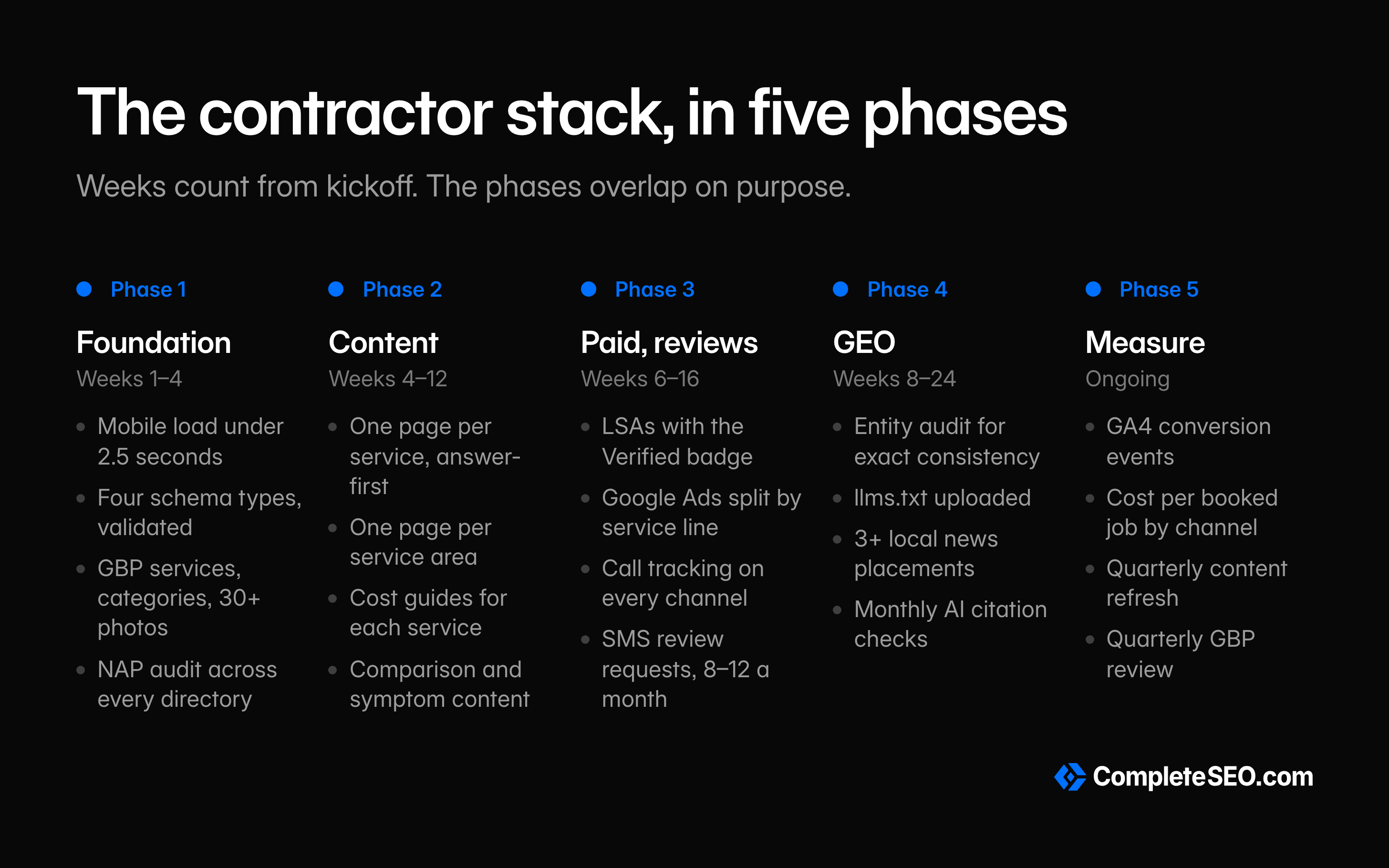
Phase 1: Foundation (Weeks 1–4)
Technical SEO
· [ ] Mobile load time under 2.5 seconds on every priority page
· [ ] HTTPS site-wide with no mixed content warnings
· [ ] XML sitemap submitted to Google Search Console
· [ ] No crawl errors in GSC
· [ ] Schema markup implemented and validated (LocalBusiness, Service, FAQPage, AggregateRating)
· [ ] Core Web Vitals passing on all key templates
Google Business Profile
· [ ] All applicable categories selected (primary + secondary)
· [ ] All predefined services added
· [ ] Custom services added for niche specialties
· [ ] Service area defined accurately (cities and zip codes, not just radius)
· [ ] Business description written with target keywords and trade specialty
· [ ] At least 30 photos uploaded (real, not stock)
· [ ] Hours, attributes, payment methods all completed
· [ ] Q&A section seeded with 5–10 common questions and answers
Citations & NAP
· [ ] NAP audit completed across BBB, Angi, Yelp, HomeAdvisor, Houzz, Nextdoor, Facebook
· [ ] Corrections submitted everywhere inconsistencies exist
· [ ] Industry-specific directories claimed (trade associations, supplier networks)
Phase 2: Content & Authority (Weeks 4–12)
Service Pages
· [ ] One dedicated page per primary service (not bundled together)
· [ ] Each page structured answer-first with question-based H2s
· [ ] FAQ section with FAQPage schema on every page
· [ ] Pricing ranges or “starting at” data included
· [ ] Above-the-fold phone number and lead form
· [ ] Real project photos (not stock)
City & Neighborhood Pages
· [ ] Dedicated page for each priority service area
· [ ] Real local content (neighborhoods, landmarks, local building codes)
· [ ] Embedded Google Map of the service area
· [ ] Testimonials from clients in that area (with permission)
Content Marketing
· [ ] Cost guides for each major service in each major market
· [ ] Comparison content (X vs. Y) for the decision points your customers actually face
· [ ] Symptom-based content for trades with diagnostic queries (HVAC, plumbing, electrical)
· [ ] Permit and timeline content for projects requiring them
Phase 3: Paid Channels & Reviews (Weeks 6–16)
Local Services Ads
· [ ] Google Verified badge earned
· [ ] All service categories selected
· [ ] Service area set
· [ ] Budget calibrated to your conversion economics
· [ ] Call tracking installed
· [ ] Lead disputes managed weekly
Google Ads PPC
· [ ] Campaigns separated by service line (not all bundled)
· [ ] Negative keyword lists built and maintained
· [ ] Call tracking installed
· [ ] Landing pages matched to ad groups (not all driving to homepage)
· [ ] Conversion tracking firing for both calls and form submissions
Review System
· [ ] Automated review request process (SMS preferred) triggered on job completion
· [ ] Response process for every review within 48 hours
· [ ] Review velocity target (e.g., 8–12 new reviews/month)
· [ ] Review embedding on website with schema markup
Phase 4: GEO & AI Visibility (Weeks 8–24)
· [ ] Entity audit across all public web mentions for exact consistency
· [ ] llms.txt file created and uploaded
· [ ] Author/expert bios with credentials on team page
· [ ] Off-site authority work: 3+ local news placements, 2+ supplier or partner case studies
· [ ] Comparison content built specifically for AI extraction
· [ ] Long-form pillar content for each major service (”complete guide to X”)
· [ ] Conversational FAQ content mirroring “People also ask” queries
· [ ] Monitoring for AI mentions (manually test ChatGPT, Perplexity, Google AI Overviews for your priority queries monthly)
Phase 5: Measurement & Iteration (Ongoing)
· [ ] Google Analytics 4 configured with conversion events
· [ ] Google Search Console monitored weekly
· [ ] Call tracking analyzed monthly (by channel, by service line)
· [ ] Cost per booked job calculated by channel
· [ ] Quarterly content refresh on top-performing pages
· [ ] Quarterly GBP optimization review
Part 9: Frequently Asked Questions
This section is structured for AI extraction, each question mirrors common homeowner and contractor queries.
What is contractor digital marketing in 2026?
Contractor digital marketing in 2026 is the integrated practice of building visibility across traditional search results, AI-generated answers, and local intent channels like Google Business Profile and Local Services Ads. It combines technical SEO, content optimized for both humans and AI systems, structured data (schema markup), local citation management, paid advertising (LSAs and PPC), and review generation into a single system rather than treating each as a separate tactic.
How is AI search different from traditional Google search for contractors?
Traditional Google search returns a list of links. AI search (Google AI Overviews, ChatGPT, Perplexity) returns a direct answer that may name specific contractors. Roughly 60% of all Google searches now end without a click, and for searches that trigger AI Overviews, the zero-click rate reaches 83%. For contractors, this means being mentioned in the answer matters more than ranking under the answer.
What is GEO (Generative Engine Optimization)?
Generative Engine Optimization is the practice of structuring your website, content, and off-site presence so that AI systems cite your business in their generated answers. Unlike traditional SEO, which optimizes for ranking on search engine results pages, GEO optimizes for citation rate within AI-generated responses. For contractors, this includes answer-first content formatting, structured data, entity consistency across the web, and authoritative off-site mentions.
Are Local Services Ads worth it for contractors in 2026?
Yes, for most contractor trades. LSA leads convert to booked customers at approximately 31%, compared to 12% for standard Google Ads, with cost per verified lead typically $40–$95 depending on trade. Contractors combining LSAs with active SEO generate 42% more leads than single-channel operators, per Semrush’s 2025 local search study.
How long does contractor SEO take to show results?
Local SEO improvements (Google Business Profile optimization, citation cleanup, review generation) typically show measurable results within 4–8 weeks. Organic rankings for competitive keywords usually take 6–12 months to compound meaningfully. AI search visibility, being cited by ChatGPT, Perplexity, or Google AI Overviews, can appear within 3–6 months for well-executed GEO work, though it remains harder to measure directly.
Do I still need a website if AI search is taking over?
Yes. Your website is the primary signal source that AI systems use to verify your business. Without a strong, well-structured website, you have nothing for AI systems to cite or for Google to rank. The website’s role is shifting from “destination” to “verification and conversion layer”, but it has become more important, not less.
What is the most common contractor marketing mistake in 2026?
Treating channels as separate tactics rather than as an integrated system. The contractors achieving real growth aren’t doing one thing well, they’re doing the foundational SEO, GBP, reviews, content, LSAs, and GEO work simultaneously, because each channel amplifies the others. Contractors who pick one channel and ignore the rest are increasingly invisible in the new search environment.
How important is Google Business Profile for AI search?
Critical. AI Overviews and conversational search tools pull business data directly from Google Business Profile when answering local queries. An incomplete or inactive GBP is one of the fastest ways to be excluded from AI-generated contractor recommendations. Active optimization, categories, services, posts, photos, Q&A, and reviews, directly influences both local rankings and AI citations.
Should contractors blog in 2026?
Yes, but the model has changed. Short keyword-stuffed posts are dead weight. What works in 2026: long-form pillar content (3,000+ words) covering a topic comprehensively, structured for both human readers and AI extraction, with question-based headings and clear, citable answers. One excellent pillar post outperforms ten thin blog posts in both rankings and AI citations.
How do reviews affect AI search visibility?
Significantly. Review volume, velocity (how recently reviews were received), and rating average are explicit signals that both Google’s local algorithms and AI systems use to assess trustworthiness. Contractors with consistent recent review activity (e.g., 8–12 new reviews per month, averaging 4.7+) materially outperform those with stale review profiles in both traditional rankings and AI recommendations.
What is llms.txt and do contractors need it?
llms.txt is a proposed standard file (similar to robots.txt) that tells AI crawlers which content on your website they can access and prioritize. It’s not required, but implementing it early signals technical sophistication and may give contractors a small advantage as AI search platforms mature. Adoption is currently low, which makes it a low-effort early-mover opportunity.
How do I know if my contracting business is showing up in AI search?
Test it manually. Once a month, ask ChatGPT, Perplexity, Google AI Overviews, and Gemini variations of your priority queries: “best [trade] in [city],” “[trade] for [specific service] in [neighborhood],” “who should I call for [problem] in [city].” Note whether your business appears, in what context, and whether the information is accurate. Track changes over time. Several SEO tools now offer AI citation tracking, but manual testing remains the most reliable method right now.
What does a complete contractor digital marketing budget look like?
Budget allocations vary by trade, market, and growth stage, but a healthy mid-sized contractor stack typically includes: technical SEO and ongoing optimization, content production (service pages, city pages, pillar content), GBP management, citation and review management, LSA spend, Google Ads PPC spend, and analytics/tracking infrastructure. The right mix depends on your conversion economics by channel, which is exactly why call tracking and attribution are non-negotiable.
What’s the biggest opportunity for contractors right now?
GEO. The competitive window for building AI citation authority in most contractor service areas is still open, and the businesses claiming that authority now will compound it over the next 12–18 months. By 2027, the gap between contractors who started GEO work in 2026 and those who didn’t will be measurable in real revenue.
The Bottom Line: The Contractors Who Move Now Win
The algorithms changed. Search behavior changed. The buying process changed. And the contractors still running 2022’s playbook, static website, a few Google Ads, hope-based SEO, are watching competitors quietly take their market share. Not because those competitors are better at their trade. Because they’re easier to find in an environment where being found is no longer a single-channel game.
AI didn’t make contractor marketing harder. It raised the bar.
The contractors gaining ground in 2026 are the ones treating search as infrastructure, not as a quarterly checkbox. They know their cost per booked job by channel. They know which service pages drive phone calls and which ones bounce. They track GBP impressions, review velocity, LSA dispute rates, and, increasingly, AI citation frequency. They treat their online presence like a job site: with accountability, systems, and measurable outcomes.
The contractors losing ground are the ones who “have a website” and “run some ads” and honestly can’t tell you whether either is working.
The window for moving is open right now. Every month your competitors invest in AI-ready contractor marketing is another month they’re building citation authority and search visibility that gets harder to displace. The contractors who claim that authority in 2026 will compound it through 2027 and beyond, and the businesses still debating whether AI search “really matters” will find themselves on the outside of conversations they used to dominate.
If your contracting business showed up in an AI-generated answer tomorrow, would you be ready for the calls?
And if it didn’t show up at all, would you even know?
At Complete SEO, we build search visibility systems for contractors and construction companies that perform across traditional search, AI-generated answers, and local search results. Month-to-month engagements. No long-term contracts. No vanity metrics. Just measurable visibility and qualified leads. Visit CompleteSEO.com to start the conversation.